
From CIA world factbook
The Arctic Ocean is the smallest of the world’s five oceans (after the Pacific Ocean, Atlantic Ocean, Indian Ocean, and the Southern Ocean). The Northwest Passage (US and Canada) and Northern Sea Route (Norway and Russia) are two important seasonal waterways. In recent years the polar ice pack has receded in the summer allowing for increased navigation and raising the possibility of future sovereignty and shipping disputes among the six countries bordering the Arctic Ocean (Canada, Denmark (Greenland), Iceland, Norway, Russia, US).1The World Factbook. “Arctic Ocean”. CIA.gov, 10 July 2023, https://www.cia.gov/the-world-factbook/oceans/arctic-ocean/ , 29 July 2023
CIA World Factbook – See more information about regions of the world and oceans2 here
From Megan Montemurno’s article
The term “ocean,” as defined by Merriam-Webster, is ”the whole body of saltwater that covers nearly three-fourths of the surface of the earth.” Comprising 1.3 billion cubic kilometers of water, this is the global body of water that covers roughly 71% of the earth. We often hear and speak of the ocean as it’s divided into five components: Arctic, Atlantic, Indian, Pacific and Southern (Antarctic). While these are often referred to as individual oceans (plural), there is no real barrier separating them. Because these are all connected, there is truly only one ocean (singular).
Depending on whom you ask, the term “sea” could actually mean the same thing as the ocean. When someone “takes to the sea,” they could be leaving any number of ports in any number of locations. While yes, generally “sea” does refer to a smaller segment of the ocean, there are different types of seas in geology: marginal and inland. A marginal sea is one that is defined by its proximity to the land that surrounds it, such as the Mediterranean Sea, the Black Sea or even the Gulf of Mexico (more on that in a minute). Alternatively, an inland sea, while also shallow, is—you guessed it—more inland and covers part of a continent. These are also sometimes called epeiric or epicontinental seas. Epeiric or inland seas have changed throughout periods of time as the earth has evolved, but they are typically landlocked and connect to the broader ocean through a very small channel. Modern-day examples of these include the Baltic Sea and the Hudson Bay.
If you’re anything like me, you may now be thinking, “How are the GULF of Mexico and Hudson BAY also seas”? This is one of those “yes, and” situations. Both bays and gulfs are also part of a sea or ocean. A bay is a broad, recessed coastal inlet where the land curves inward. There is a coastline on three sides of a bay. A gulf is a more defined and deeper inlet with the entrance more enclosed than a bay. 3Megan Montemurno. “Defining the Differences Among the Bay, Gulf, Ocean & Sea“. Ocean Conservancy, 22 December 2021, https://oceanconservancy.org/blog/2021/12/22/differences-bay-gulf-ocean-sea/. Accessed 29 July 2023
From Quora
First, oceans are waters between the continents, such as Atlantic Ocean separating Africa and Europe from North/South America; Indian Ocean separating India from Africa, Pacific Ocean separating North and South America from Asia. Ocean floor is made up of dense basaltic rock, covered with or by vast continuous body of water, which account for over two-thirds of earth area. The world has seven of these waters:
- Arctic Ocean
- the North Atlantic Ocean
- the South Atlantic Ocean
- the Indian Ocean
- the North Pacific Ocean
- the South Pacific Ocean
- the Southern (or Antarctic) Ocean 4https://www.quora.com/What-are-the-differences-between-an-ocean-a-sea-a-bay-and-a-gulf
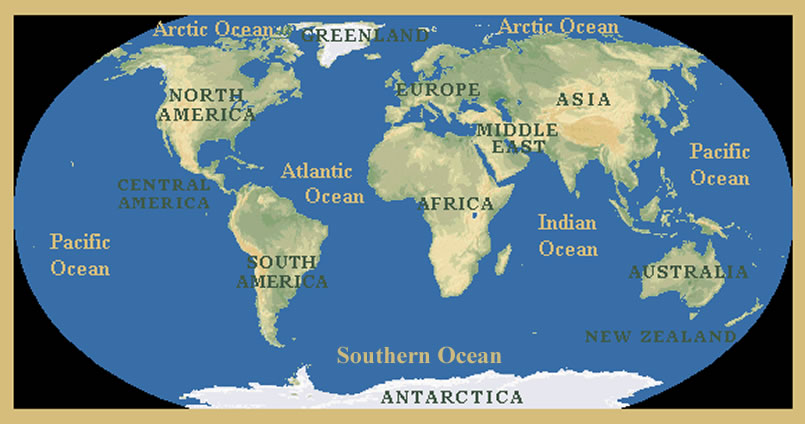

LIst of Oceans

103 Comments
Comments are closed.